Nathan Rickey (Faculty of Education, Queen’s University)
-
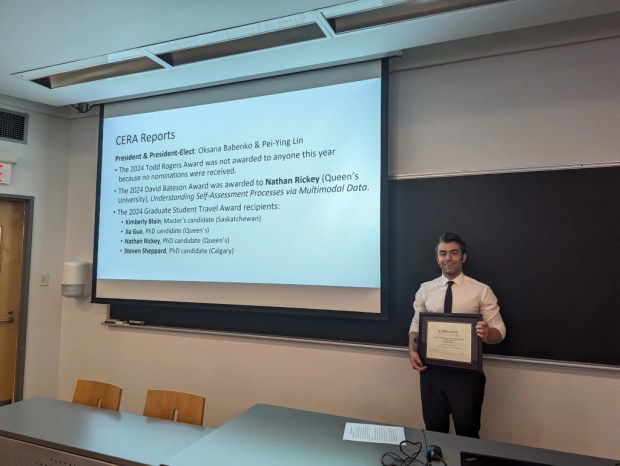
- Nathan Rickey at CSSE 2024
What is your name?
Nathan Rickey
Where are you completing your graduate studies?
Faculty of Education, Queen’s University
What is the title of your research project?
Understanding Self-Assessment Processes via Multimodal Data
What are your research questions?
The purpose of this study is to advance student self-assessment theory by examining an essential aspect of the self-assessment process. The study is guided by one overarching research question:
- What are the cognitive processes and emotions of students using rubrics and exemplars to self-assess their writing?
Please provide a brief description of your work.
Despite being a global priority for education, cultivating self-assessment remains a challenge for educators and students across contexts. Student self-assessment is consistently identified as one of the least used assessment practices in schools and universities across education contexts. A core barrier to fostering student self-assessment in classrooms is that the cognitive and affective processes that comprise student self-assessment are not yet fully understood, resulting in a lack of guidance on how students can effectively manage and develop their self-assessment processes. The purpose of this study was to begin to address this gap by investigating students’ cognitive processes and emotions while they used rubrics and exemplars to self-assess and revise their writing. Leveraging a mixed methods research design including multimodal data, we collected eye tracking data from 25 university students as they self-assessed and optionally revised their reflective essays on a computer, with on-screen access to a writing rubric and contrasting exemplars. Immediately after self-assessing, participants engaged in a gaze-cued think and emote aloud protocol, generating data on their cognitive processes and emotions throughout the self-assessment process which we analyzed qualitatively using a hybrid approach. Using joint display integration, we developed a table integrating fixation durations across five self-assessment resources (rubric, two contrasting exemplars, essay, self-feedback) with themes from the think aloud data—i.e., cognitive processes and emotions—that emerged when participants were looking at each resource. Rubrics and exemplars provoked distinct types of comparison and emotions. Specifically, participants engaged in a systemic approach when using the rubric, identifying and comparing their work to each relevant criterion independently while managing feelings of overwhelm. When using the mastering (i.e., high-quality) exemplar, participants focused on identifying aspects they could integrate into their own writing without compromising their personal writing style. When reviewing their essays, participants prioritized making important revisions while being distracted by minor writing errors. This study advances self-assessment theory and practice by elucidating what students are thinking and feeling when they use typical resources to self-assess and revise their writing. The study therefore contributes to descriptive aspects of theory, contributing a more comprehensive understanding of the phenomenon of student self-assessment to guide future research. The findings have important implications for educators. Namely, by being aware of the specific cognitive and affective processes that may be consuming students’ cognitive resources during self-assessment, educators can better support students in using resources to effectively self-assess and improve their performance. We hope that findings from this study will ultimately support researchers and educators in fostering students’ self-assessment skills—thereby enhancing their achievement and self-regulated learning.
What’s next for you and/or your work?
This study will comprise one manuscript in my dissertation, which aims to develop a theoretical framework of the cognitive, metacognitive, and affective dimensions of student self-assessment. I plan to integrate additional data channels (e.g., electrodermal activity) into the joint display to generate deeper insights into the cognitive and affective processes of student self-assessment.
What has been CERA’s impact on your research? (e.g., support, connections, opportunities)
When CSSE was held online due to COVID-19, I presented research as part of CERA sessions and learned a lot from the supportive discussions and questions. This year, I attended my first in-person CSSE and engaged in conversations with CERA members within and between sessions which have shaped my research. I have learned so much about research by attending CERA presentations—learning about other CERA members’ work always helps me think about my own work in different ways. CERA provides an extremely welcoming and supportive environment for graduate students to share their work, ask questions, build networks, and cultivate scholarly engagement. I am very grateful to have been selected for the David Bateson New Scholar Award which will support my progression as a scholar and engagement in CSSE 2025.
If you are open to us including your contact information (e.g., institutional email address) to allow readers to connect with you, please include it below.
nathan.rickey@queensu.ca
 CERA | ACCÉ