CERA at CSSE 2025 – You are invited! Keynote Address: Dr. Rachel Brophy
2025 CERA Annual Conference at George Brown College, Toronto, Ontario
(Le français suit)
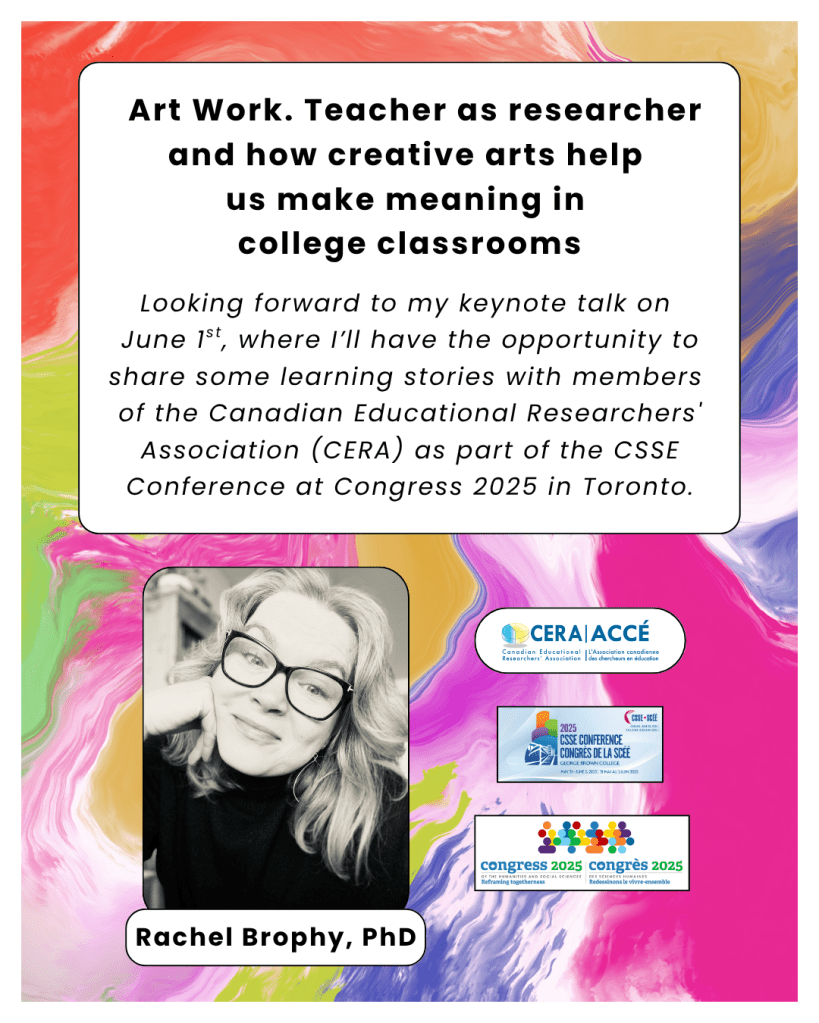
You are invited to the Canadian Educational Researchers’ Association’s annual conference at George Brown College in Toronto, Ontario from May 31 – June 5, 2025. Please register for the conference through the Canadian Society for the Study of Education website. CERA will be hosting our Annual General Meeting, which will include a free lunch for all attendees, and Dr. Rachel Brophy’s Keynote Address on June 1 from 12:15-1:15pm. Dr. Brophy’s Keynote Address is titled Art Work. Teacher as researcher and how creative arts help us make meaning in college classrooms. Please note, this keynote address is only presented in the English Language.
Vous êtes invités à la conférence annuelle de l’Association canadienne des chercheurs en éducation au George Brown College, à Toronto, du 31 mai au 5 juin 2025. Veuillez vous inscrire à la conférence sur le site Web de la Société canadienne pour l’étude de l’éducation. Le ACCÉ accueillera notre assemblée générale annuelle, qui comprendra un déjeuner gratuit pour tous les participants, et le discours de la Dre Rachel Brophy le 1 juin de 12 h 15 à 13 h 15. Le discours principal de Dre Brophy est intitulé « Art Work. Teacher as researcher and how creative arts help us make meaning in college classrooms”. Veuillez noter que ce discours d’ouverture est présenté uniquement en anglais.
Art Work. Teacher as researcher and how creative arts help us make meaning in college classrooms
This is a story about why and how I’ve incorporated the arts into my pedagogical practice as a college professor and what it can bring to learning and relations. I work with pre-service early childhood education students. In the early years sector we see educators as researchers in their work with young children. I also see myself as a researcher in the work I do with adult learners. In both cases, this role of researcher is informal, formative, nonlinear, and imbued with all kinds of emotion and meaning. When we learn to teach young children, we gather tools and strategies, explore play materials, and study policy documents and regulations. We do all of this so that we can provide playful, creative, safe and open-ended learning experiences for children. I’ve been wondering how these same kinds of learning experiences might impact college students – not only on the journey to becoming teachers, but as learners themselves. Born out of my curiosity about what playing in an imaginative space could do for educators, and with the stress and isolation of the pandemic acting as the initial catalyst, I started to transform my work. Today, a number of years later the classroom I am trying to create is a space for experimental play that is cushioned with care where we read novels, tell stories, write poetry, curate music playlists and create, build, colour & draw. In a world that’s crying out for justice and where most things are experienced through a screen, this kind of grounded classroom engagement can open up passionate and emotional spaces for adult students. These artful projects and creative explorations are not tied to a course nor to its content but instead are a method that holds the power to activate interest, welcome relationships and support students to find something of themselves in the work. In addition, this kind of environment creates connections and a sense of community, so the classroom becomes ‘our learning space’; one that is energized, emotional and shared. For me, this is always dynamic but often a daunting process that reveals many challenges. At the same time, a fire has been re-ignited in my approach to teaching and learning and provokes me to think about what it means to be a teacher-researcher.

 CERA | ACCÉ